Showing posts with label Nazarene; Sacraments. Show all posts

Monday, January 16, 2012

A Few Positive Liturgical/Sacramental Signs From Nazarene Leaders

In recent days, I have seen a few more positive signs from Nazarene leaders that there is more openness to, perhaps even an embracing of our more sacramental and liturgical heritage found in John Wesley.  -  Oh, indeed, the Church of the Nazarene has always been and (I trust) always will be a strongly "evangelical" and "holiness" oriented Wesleyan denomination.  -  If there are those who think that being "Wesleyan/Anglican" is somehow inconsistent with that, I would strongly suggest that they simply do not know what it means for one to be Wesleyan!  I strongly and thoroughly embrace the evangelical and Wesleyan-holiness identity.  I simply believe that if one leaves off the sacramental/liturgical side, one fails to be fully Wesleyan.  Further, Wesley's holiness theology is firmly rooted in his liturgical theology.

In this post, I simply want to share a few of these positive signs.  This is not a thorough analysis, nor an exhaustive report; just a few things that I have noticed in recent days.

The first comes from ++J.K. Warrick, general superintendent.*  In the most recent edition of "Grace & Peace" magazine, Dr. Warrick is interviewed. 

I think it is fair to say that Dr. Warrick would not be considered the most "liturgical/sacramental" general superintendent.  That is not to say he is anti-sacramental, but he would probably not identify himself as being "Wesleyan/Anglican."  Still, in the interview, it is reported that Dr. Warrick has stated that Nazarene congregations should offer Communion more than once a quarter (which is the absolute minimum, according to the Manual).  Then, Dr. Warrick is asked to share his thinking about this.
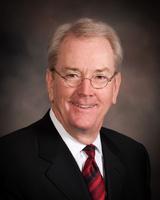
++J.K. Warrick

He indicates that in his last two or three pastorates, they served Communion once a month, sometimes more.  He confesses that he doesn't know all that God intends for Communion to be, but he is convinced there is more happening than we (typical Nazarenes) usually believe is happening.  He talks about Christ sanctifying these very common elements and making them to be a way for us to draw near to Christ.  He goes on to indicate that he wishes Nazarenes had a higher appreciation for Communion, and he affirms that Communion is a sacred moment where we meet with Christ and come together with God the Father, Son, and Holy Spirit.

Now, I know for the sacramentally minded, more could certainly be said and explained.  Still yet, I see this as a very good, positive sign that, not just with younger college and seminary grads or those who have a strong passion for the liturgical/sacramental roots of the Wesleys, but with established, evangelical, holiness, Nazarene leaders, we are rediscoverying our Wesleyan sacramental heritage!  -  (As a bit of a side note:  ++Warrick is the jurisdictional g.s. for my district.)

Also, within that same magazine (and here, I must confess, I have not read the entire magazine.  There may be much more that I could reference, but, from what I have read, within that same magazine . . .) +Jeren Rowell, superintendent of the Kansas City District, has a wonderful article on "A Wesleyan Theology of Superintendency."  Dr. Rowell clearly understands the Nazarene superintendency in terms of episcopacy and the call "to express and promote the visible unity of the body."  He looks to find his moorings in the offices of Christ (viz., Prophet, Priest, and Shepherd-King) rather than in the strategies of contemporary corporate models of leadership.

Closer to home, my own (Nazarene**) district superintendent, +Garry Pate, has recently including in
+Garry D. Pate
one of his frequent pastoral letters to the clergy on the Southwest Indiana District, two suggestions that we, Wesleyan/Anglican types, can see as very positive moves.  First, he recommended that we include in our services the liturgical declaration, following the reading of Scripture, that it is "The Word of the Lord," with the people responding, "Thanks be to God."  (The actual wording was something like, "The Word of God for the people of God," though I don't think that is quite it, either.  Anyway . . .) He picked this up from the newly elected president of Nazarene Theological Seminary, the Rev'd. Dr. David Busic.

Dr. Pate also encouraged pastors on our district to begin serving the sacrament of Holy Communion every first Sunday of the month.  -  Now, I understand that the goal for we Wesleyan/Anglican types is that we serve it, as Wesley said, every Lord's Day.  It should also be said, there are a number of Nazarene congregations on the Soutwest Indiana District (and elsewhere) that already serve Communion monthly.  However, there are still many that are on that once a quarter schedule we inherited from the circuit rider days, and I believe this suggestion from our district superintendent is a very positive move.  (Actually, I believe, strongly that Dr. Pate is making a number of very positive moves for the district.  He is being the kind of superintendent that Dr. Rowell talks about in his article.)

One more.  -  Without going into all of the history, but only mentioning that it has not always been the case that Nazarene superintendents have had hands laid on them during the prayer of consecration into the superintendency, I have recently heard (from my friend, Eric Frey+) that ++Jerry Johnson, general superintendent, emeritus, who was presiding over the consecration and installation of the first husband/wife, co-district superintendents, did, indeed, lay hands on them during the prayer of consecration. 

Again, I understand that many of the Anglican readers of this blog would call into question the episcopal status of Nazarene (and other Methodist) superintendents.  Nevertheless, I have already argued in previous articles the Nazarene & Wesleyan understanding of supreintendency/episcopacy, and that is the setting from which this report comes.  I also understand the confussion that might be out there about those times when superintendents did not have hands laid on them during the consecration.  There is a long and complicated history that I am not going to address, at this time.

The point, here, is that these are positive moves by Nazarene leadership in the areas of liturgy, sacraments and an episcopal understanding of the superintendency, for which I say, "Thanks be to God!"

______________________________
* As I have argued in previous posts, the general superintendents in the Church of the Nazarene ought to be seen, in the words of Bishop Francis Asbury, as "arch-superintendents" or "arch-bishops."  Thus, the "++" before the name.  The district superintendent is then viewed as a district bishop.  Superintendency = episcopacy; general = "arch;" and district = localize/diocese.

**Since I am serving in the United Methodist Church under the category of "Other Methodist," I thought I should indicate, for clarity sake, that I am here referring to my district superintendent in the Church of the Nazarene, where I hold my membership and orders.

Friday, March 5, 2010

Slowly But Surely; "Official" Sacramental Progress For The Church Of The Nazarene

This week I received my copy of the new 2009-2013 Manual (the Nazarene Book of Discipline). The new Manual, with all that was enacted by last summer's General Assembly, became official for the denomination as of the first of this month.

I realize that I covered many of the resolutions during the time leading up to and shortly following the General Assembly. In fact, I wrote several resolutions. (They can be viewed, here.) However, with the new Manual now in the hands of pastors and laity, I wanted to highlight two changes about which I am quite excited.

The first highlight comes under "The core duties of a pastor," at 413.9. It now states:

"To administer the sacrament of the Lord's Supper at least once a quarter. Pastors are encouraged to move toward a more frequent celebration of this means of grace. . . ." (Emphasis mine, indicating the new material.)

Now, for those who read my blog building up to the Assembly, you have seen this language before. It comes from, and is a result of, my resolution. You may also recall that much of the material in the resolution was amended out. (The full resolution may be viewed, here.)

I confess that I am disappointed that the full resolution was not adopted. However, I am quite happy that the new sentence has been added, and I would highlight two important aspects of the new sentence:

First, the General Assembly and the Manual now officially encourage pastors to a more frequent celebration of the sacrament. Most of the readers of this blog know that the Church of the Nazarene inherited the frontier practices of early Methodism. John Wesley ordained for American in order to provide the sacraments for American Methodists. He instructed elders to celebrate the Lord's Supper every Lord's Day. However, the number of clergy and the distance between churches on each circuit necessitated each congregation receiving the sacrament on a quarterly basis. That unfortunate accident of history became the norm for most in the Methodist tradition, including the Church of the Nazarene. However, now, the Manual has encouraged pastors to move toward a more frequent celebration! - It is no place near a call to a celebration every Lord's Day, but it is a sure step forward. As such, it is reason to celebrate!

(As an interesting aside, through 1923, the Manual included the following concluding sentence in the Article on the Lord's Supper: "Of the obligation to partake of the privileges of this Sacrament as often as we may be providentially permitted, there can be no doubt." I don't have a full collection of Manuals, so I don't know exactly when or why the sentence was dropped, but it does not appear in the 1936 Manual.)

The second aspect that I would like to highlight is the use of the term means of grace in reference to the sacrament of the Lord's Supper. Now, that might seem obvious (and really it is!), however, it is interesting to note that that language has, thus far, (at least as far as I can recall) only been used in one other place in the Manual. That is found in our "The Covenant of Christian Character" (formerly known as "The General Rules"). At that point, reference was made to ". . . the means of grace, including the public worship of God . . . the ministry of the Word . . . the sacrament of the Lord's Supper (1 Corinthians 11:23-30) . . ." Now, it is significant that the General Rules listed the sacrament of the Lord's Supper as a means of grace, in as much as the General Rules are not just a part of the Manual, but also a part of the Constitution, itself.

Above, I said that this identification should be obvious. We have, after all, consistently referred to Baptism and the Lord's Supper as, not just ordinances, but as sacraments. The term sacrament, in a Wesley context (and the Church of the Nazarene is a Wesleyan context) means something! Further, we have been identified as a "means of grace" tradition in various places, including the book, Articles of Faith, which Nazarene Publishing House put out to explain the Articles. The various systematic theologies produced in the denomination, including the officially sanctioned Grace, Faith and Holiness by H. Ray Dunning, also identify the sacraments as means of grace. And, of course, Rob Staples' Outward Sign and Inward Grace: The Place of Sacraments In Wesleyan Spirituality thoroughly identifies the Wesleyan understanding of the sacraments.

Nevertheless, it can be easily demonstrated that our Articles of Faith on the sacraments are the weakest (sacramentally speaking) of the three largest Wesleyan(Methodist) - holiness denominations (viz., the Church of the Nazarene, The Wesleyan Church, and the Free Methodist Church; though the Church of God, Anderson is a larger holiness church, their theology of the sacraments is foreign to the Methodist understanding). Though the Lord's Supper is identified as a sacrament in the Article, if taken out of it's Wesleyan context, one might argue that it is memorialist. Of course, even so, as my Sacramental Theology professor once said of the Article, "Certainly I believe it. I believe at least that much!" (paraphrased from memory).

So, it becomes a reason to celebrate any time the Manual makes explicit that the sacraments are "means of grace."

That leads to the second highlight I wanted to cover. The new (extensively re-worked) Article on "Christian Holiness and Entire Sanctification" includes these added words at its conclusion, "Participating in the means of grace, especially the fellowship, disciplines, and sacraments of the Church, believers grow in grace and in wholehearted love to God and neighbor" (emphasis mine).

This is the first time an Article of Faith has identified the sacraments as "means of grace," and as a means of growing in grace and holiness. Again, as I have stated, this language would not be surprising to any informed Nazarene. There would be no reason, whatsoever, to even bat an eye at it. It goes without saying, that is what we believe. The problem is, it has gone without saying within the Articles of Faith, all of this time. Finally, in the Article on Sanctification (if not in the Articles on the sacraments!), we do say it!

This may be grounds for working on a resolution for next quadrennium to include more explicit language within the two Articles on the sacraments. However, one always has to be cautious about such things, because one never knows what kind of amendments to the resolutions might be offered and passed. We could end up far worse off!

There were, of course, disappointing things at the General Assembly, but in light of these positive moves, I am rejoicing for our slowly but surely "official" sacramental progress! - Thanks be to God!