You will find, in a previous post, that I highlighted a video on a Wesleyan understanding of Baptism. The following video actually preceded that video. In this video Dr. Matt O'Reilly, an elder in the Global Methodist Church, and the host of Theology Project, interviews my friend, Dr. Ryan Danker, and they discuss the place of the Eucharist in Wesleyan theology. Dr. Danker is the Director of the John Wesley Institute in Washington, D.C.. - Like the video on Baptism, I commend it to all who are a part of the Wesleyan tradition.
Showing posts with label Wesleyan. Show all posts
Showing posts with label Wesleyan. Show all posts
Thursday, October 23, 2025

Tuesday, October 21, 2025
A Great Source for a Wesleyan Understanding of Baptism
Dr. Matt O'Reilly, an elder in the Global Methodist Church, has recently produced a couple of very good video podcasts on his channel, Theology Project, which deal with the sacraments in the Wesleyan tradition. The first one (which I plan to link after I have the chance to finish viewing it) is an interview with my friend, Dr. Ryan Danker. That interview focuses on the place of the Eucharist in Wesleyan theology. - The one, linked below, is an interview with another friend, Dr. Jonathan Powers, about the place of Baptism in Wesleyan theology. - Dr. Powers is a part of the Anglican Church in North America, and he currently teaches at one of my alma maters, Asbury Theological Seminary. - This is a really good interview, and I commend it to all who are a part of the Wesleyan tradition.
One note: You can pick up Dr. Power's book on Baptism, New Life in the Risen Christ: A Wesleyan Theology of Baptism, here.

Thursday, June 24, 2021
A Prayer To Be Prayed By Those in the Wesleyan Tradition
Here is my most recent YouTube video. It introduces a prayer that I think is a great prayer for anyone in the Wesleyan/Methodist tradition to pray. I would especially encourage those who are a part of the Wesleyan-Anglican Society to take this prayer up during the Daily Office.
Almighty God, in a time of great need you raised up your servants John and Charles Wesley, and by your Spirit inspired them to kindle a flame of sacred love which leaped and ran, an inextinguishable blaze. Grant, we ask you, that all those whose hearts have been warmed at these altar fires, being continually refreshed by your grace, may be so devoted to the increase of scriptural holiness throughout the land that in this our time of great need, your will may fully and effectively be done on earth as it is in heave; through Jesus Christ our Lord. Amen.
(My YouTube channel can be found, here.)
Friday, May 8, 2020
Misunderstandings of Perfection

The doctrines of Christian Perfection and Entire Sanctification are a distinctive emphasis within the Wesleyan tradition, and especially within the Wesleyan-holiness wing of Methodism where my own denomination, the Church of the Nazarene, is situated.
I thought that it was a good and helpful article for those who might not understand clearly what the doctrine teaches and what it doesn't teach. And so, I thought I would reproduce it for the readers of this blog (as well as commend The Wesley Study Bible to anyone looking for a new study Bible):
The terminology Christian perfection, or entire sanctification, is easily misunderstood in the
following ways. First, purity of heart does not entail perfection in knowledge. Even the entirely
sanctified must continue to study and prosper. Second, Christian perfection does not issue in
freedom from infirmities, that is, from slowness of understanding, confusion in thought, or
mistakes in judgment. Third, Christian perfection should not be described as "sinless perfection,"
lest the pure in heart conclude that they can be free from any violation of the perfect law of God,
voluntary or not. Fourth, perfect love does not eliminate temptation. Fifth, there is no state of
grace so lofty that one cannot fall from it; that is, heart purity can be lost. And finally, Wesley
rejected the idea of static perfection that did not increase in love and grace; he cautioned that a
pure heart increasingly grows in the love of God.
Sunday, October 29, 2017
Are Nazarenes Protestant? The Wesleyan Position of Catholic and Reformed
In a post, below, you will find a video from Seedbed by Dr. Larry Wood where he explains the place of John Wesley in the Protestant Reformation. - In a post on Facebook, my friend and colleague, the Rev'd. Tom Miles, made a post about how he explains to his students (at Nazarene Theological Seminary) that we really are NOT Protestant.
Below, I will post his comment in its entirety. I will follow that up by a few additional comments. (I would note, here, that I love that he ends his comments by using one of my favorite quotes from the late +Rev'd. Dr. William Greathouse.) - Here is Tom's post:
***
Protestant?
Is the Church of the Nazarene a Protestant denomination? Well, for starters, there is little doubt that the vast majority of pastors and laypersons in our churches would readily affirm that we are indeed Protestants. To the extent that self-identification counts for something, it would seem that we are Protestants.
I would suggest that the answer depends upon one's definition of "Protestant." There is a fairly popular and widespread understanding that "Protestants" are those branches of western Christianity that broke ties with the Roman Catholic Church during the sixteenth century. If one's definition of "Protestant" is "any western Christian church that is not Roman Catholic," then churches in the Wesleyan theological tradition are certainly "Protestant" denominations.
But I would argue that we ought to consider a more carefully nuanced definition of "Protestant." For one thing, the sixteenth-century Protestants split with the Roman Catholic Church because they were "protesting" something. Martin Luther, John Calvin, and the other leading Protestant reformers were protesting what they understood to be theological errors regarding salvation and Christian epistemology within the Roman Catholic Church. The Church of England, on the other hand, broke with Rome because Henry VIII was upset over the pope's refusal to grant him an annulment--hardly the same kind of "protest" that the Protestant reformers were making.
Unlike the continental Protestant traditions, which embarked on a thorough theological revisioning from the outset, articulating careful theological delineations between themselves and the Roman Catholic Church, the Church of England vacillated between Roman Catholic and Protestant sympathies for a few years before eventually settling on a middle course that rejected "extreme" positions of both the Protestants and the Roman Catholics in favor of a via media that is often summarized as "neither Roman Catholic nor Protestant, but both catholic and reformed."
Historically, our heritage lies in the Wesleyan Evangelical Revival that took place in England during the eighteenth century. Both John and Charles Wesley insisted that the Methodist movement was a revival within the Church of England and was to remain in the Church of England. They urged the Methodists to continue to attend worship at their local Church of England parish, where they would also be able to receive the Lord's Supper; in fact, the Wesleys were careful to use "lay preachers" who were not ordained (and therefore could not offer the sacraments) for Methodist society meetings and evangelical preaching--which meant that, by the Wesleys' intentional design, the Methodists had to rely on the Church of England for the sacraments. Furthermore, Methodist society meetings were not to be scheduled at times that would conflict with services in the local Church of England parish. Thus, during the Wesleys' lifetimes, the Methodists were not a "church" because they had no ordained ministers of their own. Unlike the Dissenters and Independent churches that flourished in England as protesters against the established Church of England, both John and Charles Wesley were committed to the Church of England and understood their movement to be thoroughly Anglican--even if their intentions of keeping the Methodist movement within the ecclesiastical boundaries of the Church of England were eventually ignored after their deaths. The Wesleys' emphasis on the interior spiritual life--especially the doctrine of Christian perfection--was influenced by previous Anglican writers, including William Law and Jeremy Taylor.
Theologically, the Articles of Faith of the Church of the Nazarene are based very closely on the Methodists' Articles of Religion, which are in turn an abridgement (by John Wesley himself) of the Church of England's Thirty-Nine Articles of Religion. Many of the key theological terms and turns of phrases in our Articles of Faith can be traced back to the Church of England's Thirty-Nine Articles. Some congregations in the Church of the Nazarene base their worship services on the liturgy in the Book of Common Prayer, and a few congregations actually use the Book of Common Prayer in worship. Many of the rites contained in The Church Rituals Handbook (put together in 1997 by Jesse Middendorf, published by Nazarene Publishing House) are adapted from the Book of Common Prayer. Although our Article of Faith on entire sanctification has no parallel in the Thirty-Nine Articles, the Wesleys' understanding of Christian perfection (as noted previously) was deeply influenced by Anglican writers William Law (particularly his books A Practical Treatise Upon Christian Perfection and A Serious Call to a Devout and Holy Life) and Jeremy Taylor (whose books The Rule and Exercises of Holy Living and The Rule and Exercises of Holy Dying were especially influential). The deep catholicity expressed in the opening paragraph of the Manual's "Historical Statement" likewise reflects the Church of the Nazarene's deep Anglican roots.
Given both our historical roots and our theological roots, the Wesleyan tradition is unquestionably Anglican.
From where Anglicans stand in the "middle way" between Roman Catholics and Protestants, there are "extremes" on both sides that Anglicans wish to avoid. On the Roman Catholic side, for example, we reject the insistence that the Bishop of Rome--the pope--has primacy as the spiritual leader of all of God's Church, and we reject the doctrine that papal teachings ex cathedra are infallible. On the Protestant side, we are best off avoiding the overemphasis on sola scriptura, which dismisses the role of the "tradition of the Church" and, when taken to its ultimate conclusion, seems inevitably to lead to fundamentalistic approaches to Scripture. This, it seems to me, is the fatal flaw of Protestantism.
On the positive side, we have been enriched by both Roman Catholics and Protestants. From the Roman Catholics we get our deep respect for the tradition of the Church (as enunciated in the opening paragraph of the Manual's "Historical Statement"), a high view of the role of sacraments, and an appreciation for our general superintendents as "bishops" in the Church--and not merely political leaders who campaign for election (as is the case in many Protestant denominations). From the Protestants we gain our strong emphasis on the importance of the "new birth" as well as the vital spirituality that the Pietists encouraged.
"It is time the Church of Jesus Christ overcame the disjunctions created by the 16th-century Reformation. What is called for is the 'evangelical catholicism' of John Wesley's 'middle way' in which the two historic Christian traditions were synthesized. In this synthesis the English Reformer not only recovered for the Church a viable doctrine of holiness but also pointed the way to a scriptural view and practice of the sacraments that is both apostolic and catholic." --William M. Greathouse, former General Superintendent, Church of the Nazarene, in "Foreword" to Rob L. Staples, Outward Sign and Inward Grace: The Place of Sacraments in Wesleyan Spirituality.
***
I think that Tom did a great job expressing this position!
A couple of additional considerations came up in our subsequent conversation. - First, Tom pointed out that the Manual for the Church of the Nazarene nowhere identifies us as Protestants. In fact, that term was replaced by the term Christian in 2005 (where it was situated in a section in the Appendix). - Nevertheless, it seems that those who handle the denominational website (and perhaps, too, I think in the "Nazarene Essentials" and "One Lord, One Faith, One Baptism" editions of Holiness Today) do identify us as Protestant. Of course, it must be pointed out that the two HT volumes are expected to make changes over time. Perhaps, especially as the latter volume changes when the new Manual comes out, it could make this change in wording (if, indeed, it is actually referenced in that volume!). It should also be pointed out that neither the website, nor HT carry the authority of the Manual.
Second, Tom points out that the "Historical Statement" in the Manual starts with the early church and catholicity, and then immediately moves in the second paragraph to the Wesleys and Methodism--without even giving a tip of the hat to the Protestant reformers.
Third, I would like to see the fact that Wesley, himself, in his context, identifies himself (and Anglicanism) as Protestant over against the Church of Rome. I believe that this could be addressed, but I have not seen it specifically taken up.
Fourth, I pointed out that the World Methodist Council, of which the Church of the Nazarene is a member denomination, uses the terminology of "evangelical, catholic and reformed," which points to the Anglican via media.
Finally, I want to express my thanks to Rev'd. Miles for graciously agreeing to allow me to post his comments on my blog!
Below, I will post his comment in its entirety. I will follow that up by a few additional comments. (I would note, here, that I love that he ends his comments by using one of my favorite quotes from the late +Rev'd. Dr. William Greathouse.) - Here is Tom's post:
***
Protestant?
Is the Church of the Nazarene a Protestant denomination? Well, for starters, there is little doubt that the vast majority of pastors and laypersons in our churches would readily affirm that we are indeed Protestants. To the extent that self-identification counts for something, it would seem that we are Protestants.
I would suggest that the answer depends upon one's definition of "Protestant." There is a fairly popular and widespread understanding that "Protestants" are those branches of western Christianity that broke ties with the Roman Catholic Church during the sixteenth century. If one's definition of "Protestant" is "any western Christian church that is not Roman Catholic," then churches in the Wesleyan theological tradition are certainly "Protestant" denominations.
But I would argue that we ought to consider a more carefully nuanced definition of "Protestant." For one thing, the sixteenth-century Protestants split with the Roman Catholic Church because they were "protesting" something. Martin Luther, John Calvin, and the other leading Protestant reformers were protesting what they understood to be theological errors regarding salvation and Christian epistemology within the Roman Catholic Church. The Church of England, on the other hand, broke with Rome because Henry VIII was upset over the pope's refusal to grant him an annulment--hardly the same kind of "protest" that the Protestant reformers were making.
Unlike the continental Protestant traditions, which embarked on a thorough theological revisioning from the outset, articulating careful theological delineations between themselves and the Roman Catholic Church, the Church of England vacillated between Roman Catholic and Protestant sympathies for a few years before eventually settling on a middle course that rejected "extreme" positions of both the Protestants and the Roman Catholics in favor of a via media that is often summarized as "neither Roman Catholic nor Protestant, but both catholic and reformed."
Historically, our heritage lies in the Wesleyan Evangelical Revival that took place in England during the eighteenth century. Both John and Charles Wesley insisted that the Methodist movement was a revival within the Church of England and was to remain in the Church of England. They urged the Methodists to continue to attend worship at their local Church of England parish, where they would also be able to receive the Lord's Supper; in fact, the Wesleys were careful to use "lay preachers" who were not ordained (and therefore could not offer the sacraments) for Methodist society meetings and evangelical preaching--which meant that, by the Wesleys' intentional design, the Methodists had to rely on the Church of England for the sacraments. Furthermore, Methodist society meetings were not to be scheduled at times that would conflict with services in the local Church of England parish. Thus, during the Wesleys' lifetimes, the Methodists were not a "church" because they had no ordained ministers of their own. Unlike the Dissenters and Independent churches that flourished in England as protesters against the established Church of England, both John and Charles Wesley were committed to the Church of England and understood their movement to be thoroughly Anglican--even if their intentions of keeping the Methodist movement within the ecclesiastical boundaries of the Church of England were eventually ignored after their deaths. The Wesleys' emphasis on the interior spiritual life--especially the doctrine of Christian perfection--was influenced by previous Anglican writers, including William Law and Jeremy Taylor.
Theologically, the Articles of Faith of the Church of the Nazarene are based very closely on the Methodists' Articles of Religion, which are in turn an abridgement (by John Wesley himself) of the Church of England's Thirty-Nine Articles of Religion. Many of the key theological terms and turns of phrases in our Articles of Faith can be traced back to the Church of England's Thirty-Nine Articles. Some congregations in the Church of the Nazarene base their worship services on the liturgy in the Book of Common Prayer, and a few congregations actually use the Book of Common Prayer in worship. Many of the rites contained in The Church Rituals Handbook (put together in 1997 by Jesse Middendorf, published by Nazarene Publishing House) are adapted from the Book of Common Prayer. Although our Article of Faith on entire sanctification has no parallel in the Thirty-Nine Articles, the Wesleys' understanding of Christian perfection (as noted previously) was deeply influenced by Anglican writers William Law (particularly his books A Practical Treatise Upon Christian Perfection and A Serious Call to a Devout and Holy Life) and Jeremy Taylor (whose books The Rule and Exercises of Holy Living and The Rule and Exercises of Holy Dying were especially influential). The deep catholicity expressed in the opening paragraph of the Manual's "Historical Statement" likewise reflects the Church of the Nazarene's deep Anglican roots.
Given both our historical roots and our theological roots, the Wesleyan tradition is unquestionably Anglican.
From where Anglicans stand in the "middle way" between Roman Catholics and Protestants, there are "extremes" on both sides that Anglicans wish to avoid. On the Roman Catholic side, for example, we reject the insistence that the Bishop of Rome--the pope--has primacy as the spiritual leader of all of God's Church, and we reject the doctrine that papal teachings ex cathedra are infallible. On the Protestant side, we are best off avoiding the overemphasis on sola scriptura, which dismisses the role of the "tradition of the Church" and, when taken to its ultimate conclusion, seems inevitably to lead to fundamentalistic approaches to Scripture. This, it seems to me, is the fatal flaw of Protestantism.
On the positive side, we have been enriched by both Roman Catholics and Protestants. From the Roman Catholics we get our deep respect for the tradition of the Church (as enunciated in the opening paragraph of the Manual's "Historical Statement"), a high view of the role of sacraments, and an appreciation for our general superintendents as "bishops" in the Church--and not merely political leaders who campaign for election (as is the case in many Protestant denominations). From the Protestants we gain our strong emphasis on the importance of the "new birth" as well as the vital spirituality that the Pietists encouraged.
"It is time the Church of Jesus Christ overcame the disjunctions created by the 16th-century Reformation. What is called for is the 'evangelical catholicism' of John Wesley's 'middle way' in which the two historic Christian traditions were synthesized. In this synthesis the English Reformer not only recovered for the Church a viable doctrine of holiness but also pointed the way to a scriptural view and practice of the sacraments that is both apostolic and catholic." --William M. Greathouse, former General Superintendent, Church of the Nazarene, in "Foreword" to Rob L. Staples, Outward Sign and Inward Grace: The Place of Sacraments in Wesleyan Spirituality.
***
I think that Tom did a great job expressing this position!
A couple of additional considerations came up in our subsequent conversation. - First, Tom pointed out that the Manual for the Church of the Nazarene nowhere identifies us as Protestants. In fact, that term was replaced by the term Christian in 2005 (where it was situated in a section in the Appendix). - Nevertheless, it seems that those who handle the denominational website (and perhaps, too, I think in the "Nazarene Essentials" and "One Lord, One Faith, One Baptism" editions of Holiness Today) do identify us as Protestant. Of course, it must be pointed out that the two HT volumes are expected to make changes over time. Perhaps, especially as the latter volume changes when the new Manual comes out, it could make this change in wording (if, indeed, it is actually referenced in that volume!). It should also be pointed out that neither the website, nor HT carry the authority of the Manual.
Second, Tom points out that the "Historical Statement" in the Manual starts with the early church and catholicity, and then immediately moves in the second paragraph to the Wesleys and Methodism--without even giving a tip of the hat to the Protestant reformers.
Third, I would like to see the fact that Wesley, himself, in his context, identifies himself (and Anglicanism) as Protestant over against the Church of Rome. I believe that this could be addressed, but I have not seen it specifically taken up.
Fourth, I pointed out that the World Methodist Council, of which the Church of the Nazarene is a member denomination, uses the terminology of "evangelical, catholic and reformed," which points to the Anglican via media.
Finally, I want to express my thanks to Rev'd. Miles for graciously agreeing to allow me to post his comments on my blog!
Saturday, November 29, 2014
The Book of Common Prayer
I recently posted the following video on my Facebook profile page. It comes from St. Peter's Anglican Church in Evans, Georgia. Their descriptor reads, "The Anglican Book of Common Prayer that guides our worship and forms our belief."
This, too, is our heritage as Wesleyan Christians. We are reminded that John Wesley gave to us a conservative version of the Book of Common Prayer to guide our worship and form our beliefs, as well. He called it "The Sunday Service of the Methodists in North America."
For those Wesleyan/Methodist Christians who are unfamiliar with our Prayer Book heritage, I comment "The Sunday Service" to you. - May God truly shape our faith and life.
This, too, is our heritage as Wesleyan Christians. We are reminded that John Wesley gave to us a conservative version of the Book of Common Prayer to guide our worship and form our beliefs, as well. He called it "The Sunday Service of the Methodists in North America."
For those Wesleyan/Methodist Christians who are unfamiliar with our Prayer Book heritage, I comment "The Sunday Service" to you. - May God truly shape our faith and life.
Saturday, October 26, 2013
My "Authentic Christian Worship" Video
The workshop, itself, led to the opportunity to participate in a video interview for Grace & Peace Magazine. I have added a link to the video on my sidebar. But, for those not wanting to take the time to click on the link . . . here is the video:
Todd Stepp - Authentic Christian Worship from John Wesley's Perspective from Church of the Nazarene on Vimeo.
Grace & Peace Magazine has provided a host of videos on the topic of worship (as well as other topics.) Some of the videos fit better with a Wesleyan/Anglican understanding of liturgy & the sacraments than do other videos, but the page is definitely worth taking a look at, especially for those interested in the thoughts of folks in the Church of the Nazarene. The video page can be viewed, here.
A special thanks goes out to Bryon McLaughlin & all the folks at Grace & Peace Magazine!
(Any district or local church that may be interested in my presenting a workshop along these lines can feel free to contact me! If it works with my schedule, I would love to present on this topic!)
Wednesday, April 10, 2013
Why Wesleyan?
Here is a video of Ben Witherington discussing why he is a Wesleyan Christian. Dr. Witherington teaches New Testament at Asbury Theological Seminary, where I did my doctoral work. He is an ordained elder in the United Methodist Church.
The video is a part of the "Seven Minute Seminary" series of videos through Asbury's Seedbed program.
More information about Dr. Witherignton can be found here.
The video is a part of the "Seven Minute Seminary" series of videos through Asbury's Seedbed program.
More information about Dr. Witherignton can be found here.
Tuesday, December 11, 2012
Christmas Gift Ideas
Christmas ideas for your (Nazarene) pastor. There's also a John Wesley bobble head appropriate for pastors of any Wesleyan-Methodist denomination. Take it from me, Bresee & Wesley bobble heads are great ideas!
Friday, December 9, 2011
Holiness Leaders Form New Global Wesleyan Alliance!
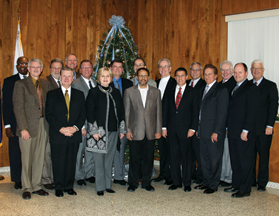 The Wesleyan Church has reported that on December 2-3, 2011, leaders of the Church of the Nazarene, The Wesleyan Church, Free Methodist Church USA, Church of God (Anderson), Churches of Christ in Christian Union, The Evangelical Church, Evangelical Methodist Church, Congregational Methodist Church, Church of Christ Holiness (USA), and the Pilgrim Holiness Church have met together to form a new partnership group called the Global Wesleyan Alliance (GWA).
The Alliance is supposed to be a means for providing greater cooperation without bringing about denominational mergers. They list some of their initial objectives as including:
- Creating greater community through intentional relationship building;
- Collaborating to pool resources, share best practices and ministers, and generate new ideas and tools;
- Convening events to promote the personal experience of holiness and collective ministries for discipleship, church health and multiplication, leadership development, prayer and networking;
- Communicating with one another more intentionally and addressing contemporary issues and public concerns with a more united voice.
Dr. Jerry Pence, General Superintendent in The Wesleyan Church, was elected as the GWA's first president. He commented, “This alliance will enable holiness denominations to achieve a historic level of cooperation and unity for evangelism, discipleship, church multiplication, compassion and justice. Our passion is to pursue the Great Commission in the spirit of the Great Commandment—making Christ known through words and deeds and millions of lives filled with perfect love.”
Each of the denominations will, of course, have to officially approve GWA partnership. According to the report, they are expecting several other denominations to participate in the GWA’s first official assembly when it is held in Circleville, Ohio, November 30-December 1, 2012.
This is exciting news!
Readers of this blog will recall that I, through my district committee, sent a resolution to the last Nazarene General Assembly that would have Nazarenes approach The Wesleyan Church and the Free Methodist Church to explore merger possibilities. That resolution was amended to leave out merger, but seek greater cooperation. - Since that time, I have come to the conclusion that denominational merger likely is not the way to go. I am very pleased with the news of this new Global Wesleyan Alliance!
Some question do remain. Will this organization be the successor of the now dormant Christian Holiness Partnership? It has been pointed out that the CHP was national in scope. It is clear from the name of the new group that the intent is that it be global in scope. Still, it should be noted that the denominations at this organizational meeting (even the global ones) are based in the U.S. Even the Free Methodist Church is specified as the U.S.A. branch of the FMC.
Will Wesleyan-Holiness denominations based outside of the U.S.A. align with the GWA? Will the GWA membership simply mirror the CHP membership? Will the Alliance reach out to some of the more conservative World Methodist Council denominations? Will this new Alliance have a negative affect on Nazarene, Wesleyan and Free Methodist membership in the World Methodist Council? (I hope not!) Will this "Wesleyan" Alliance be broadened so as to include Pentecostal holiness denominations, like the Wesleyan Holiness Consortium has done? (Personally, I think that such a move may dilute the Wesleyan-holiness message.)
For all of these answers, only time will tell.
For now, if anyone at the Nazarene Global Ministries Center happens to be reading this blog (yeah, right!), I would love to be a Nazarene representative to the GWA! (In the past, I have been appointed by the General Secretary as a denominational delegate to the Christian Holiness Partnership and the World Methodist Conference.)
The full story about the GWA can be read on The Wesleyan Church's site, here.
Wednesday, December 22, 2010
Holiness Denominational Leaders Meet to Strengthen Ties
The article, below, comes from the Nazarene Communications Network website, which apparently picked it up from The Wesleyan Church:
Holiness denomination leaders meet to strengthen ties
Tuesday, December 21, 2010
Lenexa, Kansas
 Superintendents, presidents, and bishops of 10 denominations and holiness bodies met for a two-day summit in Lenexa, Kansas, to discover ways to spread scriptural holiness and remain committed to the message in the Wesleyan-holiness tradition.
The Church of the Nazarene's Board of General Superintendents hosted the annual meeting of the Wesleyan Leaders Summit, December 3-4 at the Global Ministry Center.
Several task forces were appointed by this year's summit members to do follow-up work on topics of mutual concern, including development of an online, digital holiness classics library; procedures to allow for easier transfer of ministerial personnel and credentials for ministers in good standing between member bodies; statements for possible joint releases that address pressing social and moral issues; and cooperative scheduling of Holiness Summits (grassroots-led, regional events to encourage holiness evangelism and revival).
A subcommittee also was appointed to develop proposals for a voluntary global Wesleyan alliance that could foster greater cooperation and synergy among like-minded church bodies worldwide.
Wesleyan Leaders Summit representatives gather annually for professional enrichment, fellowship, sharing best practices, discussion of cultural trends and current issues impacting their ministries, and informal networking to encourage greater interdenominational cooperation.
Executives at this year's summit included representatives of the Church of the Nazarene, the Free Methodist Church, The Salvation Army, Church of God Ministries, Inc., The Missionary Church, the Churches of Christ in Christian Union, the Church of Christ Holiness (USA), the Congregational Methodist Church, the Methodist Protestant Church, and The Wesleyan Church.
Additional leaders from the Evangelical Church, the Evangelical Methodist Church, and the International Fellowship of Bible Churches anticipated attending, but were unable to do so at the last minute. The next Wesleyan Leaders Summit is scheduled for December 2-3, 2011, in Circleville, Ohio.
--Board of General Superintendents, The Wesleyan Church Communications
-------------------------------
In reading the article, above, I would note that all but (possibly) three of the denominations listed were members of the Christian Holiness Partnership, which seems to no longer be a functioning organization. The denominations that were not CHP members include the Church of Christ, Holiness (USA), which seems to primarily be an African-American denomination; the Methodist Protestant Church (those who did not join in the 1968 union that formed the United Methodist Church); and the Church of God Ministries, Inc. I'm not sure who this latter denomination is (thus the "possibly," above). If it is the Church of God (Anderson), it is unusual that it was not listed as "Anderson." On the other hand, if it is not the CoGA, then it is unusual that they were not at the meeting.
I find several items in this article to be interesting, and I look forward to hearing about future developments.
Among the things that I find greatly interest is the exploration of a "global Wesleyan alliance." This, I'm guessing would take the place of the national Christian Holiness Partnership. However, it will be important to pay attention to whatever terminology any future organization would use. These are obviously not the only "Wesleyan" denominations. Also considered Wesleyan denominations are such groups as the United Methodist Church, the AME, AMEZ & CME, none of which were involved in this meeting. For that matter, one can look at the World Methodist Council, itself, noting that three of the denominations in this meeting are members of the WMC. If one is simply looking for a global Wesleyan alliance, there it is!
However, what we have here are "Wesleyan-Holiness" denominations, and that is the alliance we are looking at. That is important, because some of these groups would not identify, at all, with a group like the World Methodist Council. In fact, the "Wesleyan" identity of some of the Wesleyan-holiness denominations seems to be focused only on the doctrine of Entire Sanctification. Therefore, the term "Wesleyan-Holiness" would be much more fitting for such an alliance.
In general, I wish that there were talks of merger more than "alliances" (which will come as no surprise to those who have read my blog). However, I admit, when it comes to mergers, I would be in favor of merging with those who share and strengthen the Church of the Nazarene's Methodist identity, and I would be less excited about merger with those who would dilute that identity. - Still such a "global alliance" would be an exciting development, and any attempt at strengthening cooperation is always a good thing.
Holiness denomination leaders meet to strengthen ties
Tuesday, December 21, 2010
Lenexa, Kansas

The Church of the Nazarene's Board of General Superintendents hosted the annual meeting of the Wesleyan Leaders Summit, December 3-4 at the Global Ministry Center.
Several task forces were appointed by this year's summit members to do follow-up work on topics of mutual concern, including development of an online, digital holiness classics library; procedures to allow for easier transfer of ministerial personnel and credentials for ministers in good standing between member bodies; statements for possible joint releases that address pressing social and moral issues; and cooperative scheduling of Holiness Summits (grassroots-led, regional events to encourage holiness evangelism and revival).
A subcommittee also was appointed to develop proposals for a voluntary global Wesleyan alliance that could foster greater cooperation and synergy among like-minded church bodies worldwide.
Wesleyan Leaders Summit representatives gather annually for professional enrichment, fellowship, sharing best practices, discussion of cultural trends and current issues impacting their ministries, and informal networking to encourage greater interdenominational cooperation.
Executives at this year's summit included representatives of the Church of the Nazarene, the Free Methodist Church, The Salvation Army, Church of God Ministries, Inc., The Missionary Church, the Churches of Christ in Christian Union, the Church of Christ Holiness (USA), the Congregational Methodist Church, the Methodist Protestant Church, and The Wesleyan Church.
Additional leaders from the Evangelical Church, the Evangelical Methodist Church, and the International Fellowship of Bible Churches anticipated attending, but were unable to do so at the last minute. The next Wesleyan Leaders Summit is scheduled for December 2-3, 2011, in Circleville, Ohio.
--Board of General Superintendents, The Wesleyan Church Communications
-------------------------------
In reading the article, above, I would note that all but (possibly) three of the denominations listed were members of the Christian Holiness Partnership, which seems to no longer be a functioning organization. The denominations that were not CHP members include the Church of Christ, Holiness (USA), which seems to primarily be an African-American denomination; the Methodist Protestant Church (those who did not join in the 1968 union that formed the United Methodist Church); and the Church of God Ministries, Inc. I'm not sure who this latter denomination is (thus the "possibly," above). If it is the Church of God (Anderson), it is unusual that it was not listed as "Anderson." On the other hand, if it is not the CoGA, then it is unusual that they were not at the meeting.
I find several items in this article to be interesting, and I look forward to hearing about future developments.
Among the things that I find greatly interest is the exploration of a "global Wesleyan alliance." This, I'm guessing would take the place of the national Christian Holiness Partnership. However, it will be important to pay attention to whatever terminology any future organization would use. These are obviously not the only "Wesleyan" denominations. Also considered Wesleyan denominations are such groups as the United Methodist Church, the AME, AMEZ & CME, none of which were involved in this meeting. For that matter, one can look at the World Methodist Council, itself, noting that three of the denominations in this meeting are members of the WMC. If one is simply looking for a global Wesleyan alliance, there it is!
However, what we have here are "Wesleyan-Holiness" denominations, and that is the alliance we are looking at. That is important, because some of these groups would not identify, at all, with a group like the World Methodist Council. In fact, the "Wesleyan" identity of some of the Wesleyan-holiness denominations seems to be focused only on the doctrine of Entire Sanctification. Therefore, the term "Wesleyan-Holiness" would be much more fitting for such an alliance.
In general, I wish that there were talks of merger more than "alliances" (which will come as no surprise to those who have read my blog). However, I admit, when it comes to mergers, I would be in favor of merging with those who share and strengthen the Church of the Nazarene's Methodist identity, and I would be less excited about merger with those who would dilute that identity. - Still such a "global alliance" would be an exciting development, and any attempt at strengthening cooperation is always a good thing.
Friday, January 15, 2010
Two Articles Worth Reading
In recent days I have had the opportunity to "meet" another one of my brothers in the Order of Saint Luke, via our cyber-chapter. His name is Wade Powell, and he serves as the district lay leader of the San Angelo District of the Southwest Texas Conference of the United Methodist Church.
I would like to commend to you two articles that Br. Wade has written and posted on his website. The first is titled, "What's the Big Deal About Holy Communion?". The second is, "How can a baby be Baptized if it doesn't know what it's doing?". - Though written from within the United Methodist denomination, specifically, they present a perspective that I would commend to all within the Wesleyan/Methodist tradition.
The articles can be viewed by clicking here.
Thanks Br. Wade!
I would like to commend to you two articles that Br. Wade has written and posted on his website. The first is titled, "What's the Big Deal About Holy Communion?". The second is, "How can a baby be Baptized if it doesn't know what it's doing?". - Though written from within the United Methodist denomination, specifically, they present a perspective that I would commend to all within the Wesleyan/Methodist tradition.
The articles can be viewed by clicking here.
Thanks Br. Wade!
Friday, January 2, 2009
A New Year's Covenant Prayer
The following "Covenant Prayer" is listed as #484 in Sing to the Lord, the hymnal of the Church of the Nazarene. It is there abbreviated and adapted from the Rev'd. John Wesley's Covenant Service. A much more complete edition o the entire Covenant Service, including a more complete rendition of this prayer, can be found in the back of the book, Wesley Hymns, compiled by Ken Bible and also published by Lillenas Publishing (Nazarene Publishing House).
While I commend the entire Wesley Covenant Service to all, I offer, here, the shorter adapted version from the Nazarene hymnal and invite all who will to join in this prayer at the beginning of this New Year:
While I commend the entire Wesley Covenant Service to all, I offer, here, the shorter adapted version from the Nazarene hymnal and invite all who will to join in this prayer at the beginning of this New Year:
I am no longer my own, but Yours.
Put me to what You will,
Rank me with whom You will.
Put me to doing,
Put me to suffering.
Let me be employed by You or laid aside for You,
Exalted for You or brought low by You.
Let me have all things,
Let me have nothing.
I freely and heartily yield all things to Your pleasure and disposal.
And now, O glorious and blessed God,
Father, Son, and Holy Spirit,
You are mine, and I am Yours.
So be it.
And the covenant which I have made on earth,
Let it be ratified in heaven.
Amen.
Friday, August 15, 2008
AME Zion Makes History

As pointed out in the comments on my previous post, the African Methodist Episcopal Zion Church did, indeed, make history by electing their first female bishop! The Rev'd. Mildred B. Hines was elected to the episcopacy during their recent General conference.
With the AME, the AMEZ, the Church of the Nazarene, the UMC, and The Wesleyan churches all having taken the step of electing women to the episcopal role, one wonders if the CME and the Free Methodists churches will do the same during their next General Conferences.
In addition to electing Rev'd. Hines as bishop, I am happy to report that one of the other two elected to the episcopacy was the Rev'd. Darryl Starnes. Bishop Starnes previously led the evangelism wing for his denomination. I know Bishop Starnes through the Order of the FLAME, World Methodist Evangelism/World Methodist Council, and I congratulate him on his election!
May God's grace, anointing and wisdom be upon all Methodist/Wesleyan Bishops/General Superintendents.
--------------------
For an interview with Bishop Hines click here.
For an interview with Bishop Starnes click here.
For a different perspective concerning women in holy orders, read the statement put out by the Anglican Province of America entitled, The Male Character of Holy Orders: Dogma Not Discipline, or see the blog article entitled, An Icon of Christ, written by Fr. David Straw who ministers in a United Episcopal Church located in Evansville, IN.
Thursday, July 17, 2008
More Church Meetings
Earlier I wrote concerning the general conference of the United Methodist Church and The Wesleyan Church, both of which are sister Wesleyan/Methodist denominations to the Church of the Nazarene (though the latter is, of course, much closer to us). In addition, the African Methodist Episcopal Church (AME) just concluded their general conference, last week, and the African Methodist Episcopal Zion (AMEZ) Church began their general conference yesterday.
 A.M.E.
There seems to be very little that took place at the AME general conference that would be of much interest to those outside of the AME Church. One exception is that they did discuss the institution of a permanent order of deacons. Such a move would bring them in line with the UMC, as well as the Church of the Nazarene. However, they declined to do so, retaining, instead, their transitional deacon orders.
 A.M.E.Z.
 It is clear that the Anglican Communion is in very bad shape. Schism is not just knocking on their ecclesiastic door, but about to knock it down, and it appears that there is nothing that Archbishop of Canterbury can (or will) do about it.
 A.M.E.
There seems to be very little that took place at the AME general conference that would be of much interest to those outside of the AME Church. One exception is that they did discuss the institution of a permanent order of deacons. Such a move would bring them in line with the UMC, as well as the Church of the Nazarene. However, they declined to do so, retaining, instead, their transitional deacon orders.
One other note of interest in these political times is that Senator Barack Obama spoke at the general conference. It was reported that Senator John McCain received an invitation to speak, as well, be failed to accept it.
 A.M.E.Z.
 Upon the heals of The Wesleyan Church's election of their first female General Superintendent (though probably without reference or even any thought given to The Wesleyan Church's action), it has publicly been asked if the AMEZ Church is ready to elect their first female Bishop. - Time will tell.
One thing is certain, it would be good for all of us in the Wesleyan/Methodist tradition to hold up our sisters and brothers in the AMEZ as they meet in general conference. - May God grant them wisdom and direction in all their decisions, and may God grant to them renewal and revival by the Holy Spirit.
THE ANGLICAN COMMUNION 

Across the pond, the Anglicans have begun their every ten year (or so) meeting of bishops at Lambeth. This meeting will take place with a quarter of the Anglican bishops declining to attend in protest of "liberal" actions of The Episcopal Church in America (especially regarding homosexuality) and those who share similar sentiments.
 It is clear that the Anglican Communion is in very bad shape. Schism is not just knocking on their ecclesiastic door, but about to knock it down, and it appears that there is nothing that Archbishop of Canterbury can (or will) do about it.
 Anglicanism has splintered in America, with the "orthodox" groups forming their "Common Cause Partnership." Many Anglo-catholics in England are on their way to Rome, after the Church of England voted to ordain women as bishops. - They certainly need the prayers of all faithful Christians.
SWID
Closer to home, and not nearly as significant globally or denominationally, my own Southwest Indiana District of the Church of the Nazarene prepares to meet at our annual district assembly, next week. - We, too, would appreciate any prayers prayed on our behalf.
Subscribe to:
Posts (Atom)